8nd Stage - Commentary on the Jubilee prayer
Commentary on the Jubilee prayer
The final step offered a simple plan for experiencing consecration to the Sacred Heart. In this eighth step, here is a commentary on the prayer for the 350th Jubilee.
Prayer for the 350th Jubilee
Lord Jesus,
You revealed to Saint Margaret Mary Your Heart, so passionately filled with love for all men and for each one in particular. Today, You invite us to draw from the fount of Your Heart, which remains more open than ever.
In the sacrament of love that is the Eucharist,
We offer you our labours and our weariness: give us rest; ;
We lay before you our suffering and our wounds: console us and heal us; ;
We present to you our hardness of heart: transform us with gentleness and humility; ;
We lay before you our ingratitudes and our indifferences: may we give you love for love; ;
We tell you of our thirst to love you and to proclaim you: send us forth in the power of your Holy Spirit.
This prayer is made up of three parts: the introduction, the litanic petitions, and the final peroration. Its commentary allows one to grasp much of what has been said in the prayer and to enter more deeply into the devotion to the Heart of Jesus.
The introduction
Lord Jesus, you revealed to St Margaret Mary your Heart so passionate with love for all men and for each one in particular.
Through baptism, Christians are bound and consecrated to Jesus, our Saviour and Lord of our entire lives. The primary cause of the corruption of the Christian life comes from the forgetting and ignorance of these commitments made at baptism. However, we experience ourselves as weak and changeable. The purity of this first and foundational consecration is altered by our sins and frailties, like a spring that has become sandy.
The way to remedy this situation is to remember the obligations undertaken at baptism and to renew the promises of holy baptism. It is necessary for us, at various moments in our lives, to receive a «reminder». Thus, every year, we renew the promises of our baptism during the Easter Vigil.
Consecration to the Heart of Jesus is an opportunity for us to rediscover the purity and strength of our baptismal consecration. It is a new stage in our fidelity to our baptism. It is what the Church calls a pious exercise, in the same way as the rosary or the Stations of the Cross, for example.
Today, you invite us to draw from the source of your Heart, which is more open than ever.
The second sentence shows the contemporary relevance of the grace experienced at Paray and contains an allusion to the canticle from Isaiah 12: «With joy you will draw water from the wells of salvation» (v. 3); a verse that gave its name to Pope Pius XII's 1956 encyclical, *Haurietis Aquas in Gaudio*. The closing sentence echoes the affirmation made by Pope John Paul II on 6 January 2001, at the closing of the Holy Door of the Great Jubilee of the year 2000 in Rome: «With the closing of the Holy Door, a symbol of Christ is closed. But the Heart of Jesus remains open more than ever.»
The six litanies of request
Lord, we consecrate ourselves to your Heart, burning furnace of charity
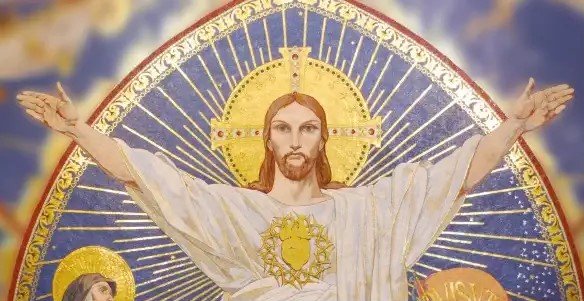
Finally, the third part appears as the culmination of the spiritual movement of this prayer of consecration to the Heart of Jesus. It is good to remember that the place of offering is the Eucharist, as we said earlier. Consecrating oneself to the Heart of Jesus is nothing other than consecrating oneself to his person, to Jesus himself. Jesus spoke of his Heart to Saint Margaret Mary as «the burning furnace of pure love» (letter to the mother of Saumaise). Throughout the apparitions, it is the symbol of fire that predominates, as for example in the apparition of 1674 reproduced on the fresco in the Chapel of the Apparitions: «Jesus Christ, my sweet Master, presented himself to me, all dazzling with glory with his five wounds, shining like five suns, and from this sacred Humanity came flames from all sides, but especially from his adorable breast, which resembled a furnace; and having opened, revealed to me his all-loving and all-loving Heart, which was the living source of these flames. »
Make us instruments that draw hearts to your Love.
In the 1678 retreat, Margaret Mary notes this affirmation from Jesus: «I want you to be my instrument for drawing hearts to my love,» which is repeated in our prayer.
Burn us with your compassion so that we may bear witness to the world of this Heart that has loved us so much. Amen.
The request «to burn with compassion» is situated in the symbolic register of the fire in which Marguerite-Marie's spiritual experience is situated, as we have just said. It is a question of entering into «the sentiments that are in Christ Jesus» (Phil 2:5), into the compassion for the crowds that overwhelmed his heart: «When Jesus saw the crowds, he felt compassion for them, because they were helpless and distressed, like sheep without a shepherd» (Mt 9:36). (Mt 9:36). The prayer ends with the words of June 1675, which appear to be the pinnacle of Saint Margaret Mary's spiritual experience: «This is the Heart that so loved mankind that it spared nothing to the point of exhausting itself and consuming itself in order to show them its love».»
In the ninth step, we will see how personal consecration can expand into a family and community endeavour.
In the sacrament of love that is the Eucharist,
The second part is introduced by the expression «Sacrament of love», which the Lord used to designate the Eucharist during the great Apparition of June 1675. It is composed of five litanies, which put pilgrims in the school of the spiritual experience of Saint Margaret Mary.
We offer you our labours and our weariness: give us rest; ;
Firstly, on 27 December 1673, she rested for a long time on the Heart of Jesus: «He made me rest for a very long time on his divine breast». In a letter to Father Croiset, she specified that this rest lasted «several hours». In so doing, she was responding to Jesus« call in the Gospel to come and rest on his Heart: »Come to me, all you who labour under a heavy burden, and I will give you rest. Take my yoke upon you and become my disciples, for I am gentle and humble of heart, and you will find rest for your souls«. (Mt 11, 28-29). The disciple Saint John was the first to have such an experience at the Last Supper (Jn 13:25), a fact of such importance that the Gospel refers to it again after the resurrection (Jn 21:20). Very early on, the first Christians associated John with this very special experience. In 180 AD, Irenaeus of Lyons wrote: »Then John, the disciple of the Lord, who rested on his breast, also published the Gospel, while he was living in Ephesus in Asia" (Against Heresies III, 1, 1).
We lay before you our suffering and our wounds: console us and heal us; ;
Secondly, the Heart of Jesus is a source of consolation and healing. Pope Francis invites us to bring our wounds close to the wounds of Jesus. The hymn in the first epistle of Peter applies to Jesus what the prophet Isaiah announced in the 4th poem of the suffering servant: «By his wounds we are healed» (Isaiah 53:5 and 1 Pet 2:24). During the audience granted to the symposium organised by the shrine of Paray on Spiritual Reparation in May 2024, Pope Francis prayed «that the shrine of Paray-le-Monial may always be a place of consolation and mercy for everyone in search of inner peace».»
The analogy of the Heart with the image of the sun and the furnace at the time of the appearance of 1674 recalls the verse from the prophet Malachi «the Sun of justice will rise: it will bring healing in its rays» (Mal 3:20), frequently cited in Parodian spirituality.
We present to you our hardness of heart: transform us with gentleness and humility; ;
Thirdly, on December 27th, Jesus asked Marguerite-Marie for her heart. «I begged him to [take] it, which he did, and placed it in his adorable one, in which he showed it to me as a tiny atom consuming itself in that ardent furnace, from which, drawing it out as a burning flame in the shape of a heart, he [placed] it back in the place where he had taken it.» In doing so, the Lord fulfils the promise prophesied in Ezekiel: «I will give you a new heart, I will put a new spirit within you. I will remove the stony heart from your flesh; I will give you a heart of flesh. I will put my spirit within you, and I will make you walk according to my laws» (Ezekiel 3:26-27). Jesus describes his Heart as «gentle and humble» (Matthew 11:29) and notes the hardness of heart of his interlocutors or disciples (for example, in Matthew 19:8 or Mark 6:52).
We lay before you our ingratitudes and our indifferences: may we give you love for love; ;
Fourthly, when it appeared in 1674, Jesus complained about the lack of love from humankind: «He revealed to me the inexplicable wonders of his pure love, and the extent to which he had carried it in loving men, from whom he received only ingratitude and ignorance.» He asked Marguerite-Marie to «return love for love,» an expression that appears repeatedly in the Visitandine's writing. This is, moreover, the theme chosen for this 350th anniversary Jubilee.
We tell you of our thirst to love you and to proclaim you: send us forth in the power of your Holy Spirit.
Fifthly, devotion to the Sacred Heart renews us in our missionary zeal to bear witness to this burning love in the world, something to which Marguerite-Marie and Claude La Colombière devoted themselves, each according to his own calling. «My divine Heart is so passionate with love for men, and for you in particular, that it can no longer contain within itself the flames of its ardent charity, so it must spread them through you, and manifest itself to them to enrich them with its precious treasures that I am discovering for you», Jesus said during the apparition of 1673. The theme of thirst associated with love is also very present in the apparitions. In one of her letters to Father Croiset, Marguerite-Marie said that Jesus had chosen her as a "child of love". «He was »an instrument for establishing this devotion and attracting hearts to love His adorable Son, who had such an ardent thirst to be known, loved and honoured by men".»
The final peroration
Lord, we consecrate ourselves to your Heart, burning furnace of charity
Finally, the third part appears as the culmination of the spiritual movement of this prayer of consecration to the Heart of Jesus. It is good to remember that the place of offering is the Eucharist, as we said earlier. Consecrating oneself to the Heart of Jesus is nothing other than consecrating oneself to his person, to Jesus himself. Jesus spoke of his Heart to Saint Margaret Mary as «the burning furnace of pure love» (letter to the mother of Saumaise). Throughout the apparitions, it is the symbol of fire that predominates, as for example in the apparition of 1674 reproduced on the fresco in the Chapel of the Apparitions: «Jesus Christ, my sweet Master, presented himself to me, all dazzling with glory with his five wounds, shining like five suns, and from this sacred Humanity came flames from all sides, but especially from his adorable breast, which resembled a furnace; and having opened, revealed to me his all-loving and all-loving Heart, which was the living source of these flames. »
Make us instruments that draw hearts to your Love.
In the 1678 retreat, Margaret Mary notes this affirmation from Jesus: «I want you to be my instrument for drawing hearts to my love,» which is repeated in our prayer.
Burn us with your compassion so that we may bear witness to the world of this Heart that has loved us so much. Amen.
The request «to burn with compassion» is situated in the symbolic register of the fire in which Marguerite-Marie's spiritual experience is situated, as we have just said. It is a question of entering into «the sentiments that are in Christ Jesus» (Phil 2:5), into the compassion for the crowds that overwhelmed his heart: «When Jesus saw the crowds, he felt compassion for them, because they were helpless and distressed, like sheep without a shepherd» (Mt 9:36). (Mt 9:36). The prayer ends with the words of June 1675, which appear to be the pinnacle of Saint Margaret Mary's spiritual experience: «This is the Heart that so loved mankind that it spared nothing to the point of exhausting itself and consuming itself in order to show them its love».»
In the ninth step, we will see how personal consecration can expand into a family and community endeavour.